

one who tinkers, one who entertains, one who protects;
one who creates, one who discovers, one who lives;
one who is brave and sensitive all at once.
He who is endless reflections of me.
Are you a knight? A healer? A druid? A bard? A rogue? A wizard?
Are you all at once?
Do you interlock muddy fingers with ones dipped in moon water?
Does the sun shine a peek upon your Elfish ears? Your faunish antler stubs? Your flippers caress sea foam and your paws prance through clovers.
Are you in a moving picture? Etched upon a page? Painted on canvas? Scuplted from terracotta and bronze? Are you in the audio waves?
Do you live within gramophones or windy tree leaves?
Or both? Or both..? Or both...?
Or All.
You are all of me and I will protect you, little boy that is me.
I will Protect Prince Damiana because he is me, after all.
After all, he is me.

Endemic Bestiary
.png) Impries (Umbrafae dicentra) are small creatures most often found in bleeding hearts meadows across Wistcholy. They serve as both tenders and pollinators to the flora, sustaining their identifiable lanterns with petal essence. Impries are mostly nocturnal and forage two hexagons from the petals of bleeding hearts every night with their retractable sharp claws. Though the reasoning for the hexagonal shape is not certain, it is speculated that it may have physiological significance to the imprie. The damage inflicted to the bleeding hearts actually assists in their accelerated growth, much like blueberries growing after a wildfire.
Impries (Umbrafae dicentra) are small creatures most often found in bleeding hearts meadows across Wistcholy. They serve as both tenders and pollinators to the flora, sustaining their identifiable lanterns with petal essence. Impries are mostly nocturnal and forage two hexagons from the petals of bleeding hearts every night with their retractable sharp claws. Though the reasoning for the hexagonal shape is not certain, it is speculated that it may have physiological significance to the imprie. The damage inflicted to the bleeding hearts actually assists in their accelerated growth, much like blueberries growing after a wildfire.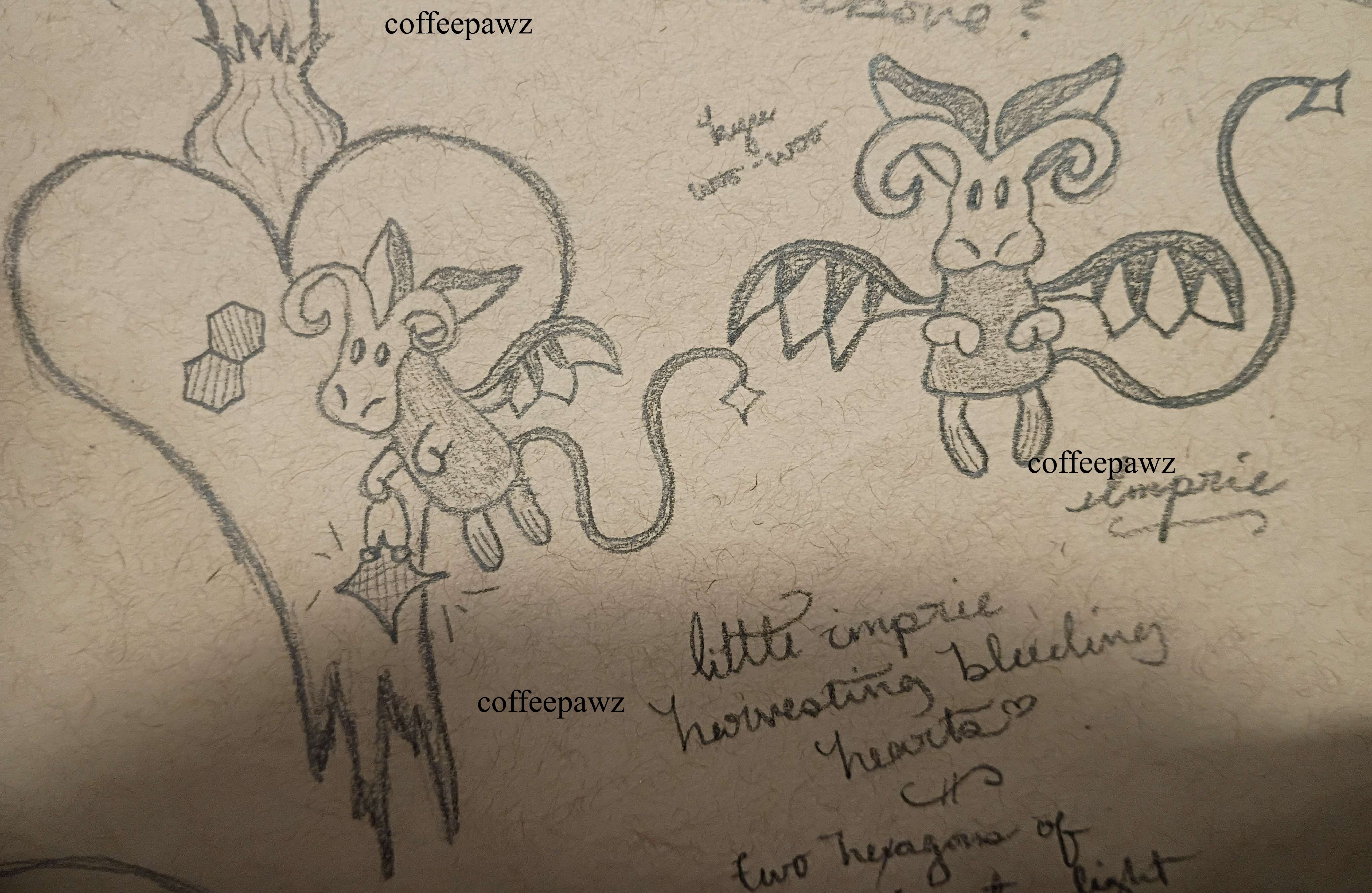 Imprie coloration varies and greatly depends on region, especially taking into consideration the species of bleeding hearts most common in the area. Lanterns and tail tips will match the color of the flower most often foraged. Fur color ranges in neutral, earthy colors while their faces, arms, hands, and feet remain the same. Their faces in particular have a bony look and texture which is found in all species of imprie.
 While mostly harmless when unprovoked, the imprie can transform into an alarming beast befitting of their name's prefix. Their fur stands up, making them appear larger, their eyes widen and a mouthful of sizable canines are exposed. Their claws are thick, sword-like, and no longer fit to carry their lanterns; even in this feral state, they take the time to set down their lanterns gently. Interestingly enough, these physical changes have been most often reported during diurnal hours; not many have witnessed this, however.
Who is Here? Where can I Go?
To Come:Geography, Demography, Fauna, Flora, and Places of Wistcholy